

Monday, April 10, 2017
Wednesday, February 8, 2017

Sunday, February 5, 2017


Wednesday, February 1, 2017
Faux Tilt Shifts Bratislava
Since it's looking like I won't be traveling in 2017, I decided to reminisce a bit with Photoshop and images from past travels. Here are a couple of faux tilt shifts (a miniature looking image effect), taking advantage of images from a recent nice day out in Bratislava. The first image is from the New Bridge on the north bank side of the Danube River, looking east. The second image is from the observation deck of the bridge's suspension tower on the Danube's south bank, the view into into neighboring Hungary.


Monday, January 25, 2016
Charles Bridge
My latest visit to Prague was mostly spent indoors as I was forced to plan my activities carefully, to avoid prolonged exposure to the ever present ice cold wind.
I made one exception, which was to linger on and around Charles Bridge (Karlův most), an exquisite example of medieval architecture. For centuries, as the only bridge which crossed the Vltava River in Prague, it is still guarded by three bridge towers, two of them of Romanesque influence on the Lesser Quarter side, the third a magnificent Gothic tower on the old town side.


If one is aware of the history of the bridge, it is a unique experience to pause and examine the Gothic tower close up, noting the coats of arms of the countries governed during the reign of Charles IV, as well as the statues of St. Vitus, Charles IV, Wenceslas IV, St. Vojtech (Adalbert) and Sigmund. It is here, if one can imagine a scene from 1621, that 27 severed heads belonging to noble leaders of what is known as the Bohemian Revolt, were displayed as a reminder of the consequence of armed opposition to authority. The executions took place only a short distance away in the Old Town Square, on what is referred to by the Czechs as their "Day of Blood" -- one can find their memorial in brick there. This was a key moment in the Thirty Years War (1618-1648), which led to the Peace of Westphalia and the beginning of our modern international political system.

Today, between the towers, the bridge is adorned with 30 Baroque style statues (with a few exceptions), originally erected in the 1700s, now all replaced by replicas. It is remarkable this bridge has survived numerous floods, erosion, battles, and progress -- a venue for public transportation from horse and electric trams, to bus and other vehicular traffic. Since its last restoration began in 1965, the bridge has remained a pedestrian venue.


If one is aware of the history of the bridge, it is a unique experience to pause and examine the Gothic tower close up, noting the coats of arms of the countries governed during the reign of Charles IV, as well as the statues of St. Vitus, Charles IV, Wenceslas IV, St. Vojtech (Adalbert) and Sigmund. It is here, if one can imagine a scene from 1621, that 27 severed heads belonging to noble leaders of what is known as the Bohemian Revolt, were displayed as a reminder of the consequence of armed opposition to authority. The executions took place only a short distance away in the Old Town Square, on what is referred to by the Czechs as their "Day of Blood" -- one can find their memorial in brick there. This was a key moment in the Thirty Years War (1618-1648), which led to the Peace of Westphalia and the beginning of our modern international political system.

Today, between the towers, the bridge is adorned with 30 Baroque style statues (with a few exceptions), originally erected in the 1700s, now all replaced by replicas. It is remarkable this bridge has survived numerous floods, erosion, battles, and progress -- a venue for public transportation from horse and electric trams, to bus and other vehicular traffic. Since its last restoration began in 1965, the bridge has remained a pedestrian venue.
Thursday, December 10, 2015
The Orloj


Prague (Praha) is often referred to as the "Golden City" or the "City of a 100 Spires". Certainly, it is a city full of unique sites, from a range of eras. I was instantly drawn to the Gothic charm and prowess resident on both sides of the Vltava River, elegantly connected by Charles' Bridge. Against historic odds, Prague has somehow been able to preserve certain exquisite examples of its medieval past. In particular, its clock tower is a sight to behold.

Prague’s Astronomical Clock (Pražský orloj) is one of these unique medieval survivors. A prominent feature of Prague’s old centrum, a tower clock on the southern side of the Old Town Hall, it is one of the oldest of its kind. The first one appeared in Padua (1344), followed by second in Strasbourg (1354). And the Orloj is the oldest of those with functioning original clockworks -- most European medieval tower clock mechanisms have been replaced with modern, often electric, clockworks. Not only has the Orloj's clockworks functioned for over 600 years, the astronomical dial, shaped in the form of an astrolabe, survives in its original form.
Prague’s Tower Clock is composed of three parts. The first part is the astronomical dial (1410), representing various astronomical details such as the Sun and the Moon -- designed by clockmaker Mikuláš of Kadaň and Charles University astronomy and mathematics professor Jan Šindel. Originally, this was a monument to the science of astronomy, meant to mirror the movement of celestial bodies. Two nearby sundials, removed in 1911, were used to crosscheck the sun's actual position with the dial. Added later in several stages, beginning in the later part of the 15th century, are an hourly clockwork parade of various sculptures, to include the Apostles, and a calendar dial. The lone tower housing the Orloj was erected in 1381.


There are many legends surrounding the Orloj. The more prominent one centers on the Orloj’s original master clockmaker. Local generations have passed on a tale which vividly describes how the city fathers gouged out the clockmaker's eyes with a hot poker. So jealous were they of the Orloj, they were hard set to prevent him from building another similar masterpiece in a rival city. In retaliation, the now blind clockmaker damaged his creation beyond repair, with the aid of his loyal apprentice. Those who later tried to fix it were said to have either gone wildly mad or died -- tragically and cursed.
There are several other minor tales about the clock. One declares the Skeleton sculpture possesses fortune-telling powers. Another one notes that if the clock is left damaged for too long, hard times will fall upon the Czechs. And if a young man and woman together witness the clock striking on the hour, they are destined to marry.
In reality, all stories aside, the clock simply has not been very reliable. The Orloj has stopped working many times throughout the centuries, whether due to damage or neglect, the lack of competent technical skill or funds to conduct repairs. And the Orloj suffered heavy damage during the Prague Uprising (May 1945). German forces unleashed an artillery barrage upon the old city square -- the Old Town Hall and nearby buildings burned along with the Orloj’s wooden sculptures and the calendar dial face. By 1948, the clock was repaired, functioning again, with the wooden Apostles restored.
Yes, Prague has repeatedly managed to save its clock tower.
Saturday, December 5, 2015
Vianočný Trh, Bratislava


Tuesday, December 1, 2015
Weihnachtsmärkte Wien
Europe's Christmas markets are well worth experiencing. I'm tempted to list what I consider the best, say of five, maybe ten. But the more that I've pondered this approach, the more I am convinced that each is unique enough to simply to invite you to the nearest one.


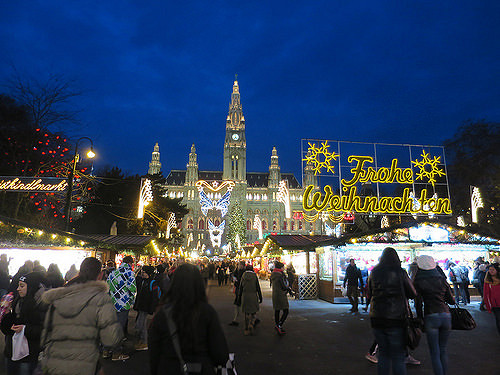
Vienna's was my first. I noticed from a distance that its City Hall (Rathaus) was literally a giant Advent calendar, with corresponding numbered windows -- curtained. Beginning on the the 1st of December, the appropriate covering is removed, revealing a Christmas scene. This obviously continues until the 24th -- I could see the centrally located "24". I had to move in for a closer look. I discovered that this Christkindlmarkt is the larger, more commercial of Vienna's numerous Christmas markets.
Yes, there are more -- many more.
Yes, there are more -- many more.


Saturday, October 31, 2015

Friday, October 30, 2015
Wien Architecture (1)
Common period architecture, often viewed in Central Europe, this nice example in Wien's centrum.

I think I could manage with a bit of Baroque.

Tuesday, October 20, 2015

Thursday, October 15, 2015
Bratislava Architecture (1)
Often, one stumbles across a grand façade, begging restoration -- this one in Bratislava's Old Town.

Thursday, October 1, 2015

Wednesday, September 30, 2015
Street Performers, Wien
 Vienna's street performers can be quite entertaining. On a typical day, rows of silver or gold Victorian statue performers decorate Stephansplatz. Puppet, magic shows, break dancers dispersed. Vying for attention. Timing their performances against each other. Some acts quite good, others a little cheesy. But every crowd acknowledged to have been the best. Tips, please. No pictures without compensation. Thank you.
Friday, July 10, 2015
Out and About, Vienna's Volksgarten
I have often found myself taking a respite on the steps of this temple in Vienna's Volksgarten.

More in line with the timing of Greek Revival architecture, this temple is a neo-classical reproduction of the Temple of Hephaestus in Athens (or the Theseus). Built in the center of Vienna's Volksgarten in the early 1800s, the park was created after Napoleon demolished a bastion near the imperial palace and the temple was added shortly thereafter. The park was further expanded later when Vienna's city fortifications were torn down, replaced by the Ringstraße.
The temple's central location is a natural place to meet, or loiter in
transit from one Vienna site to another -- or simply a convenient stop
to nibble on a packed lunch. It is a type of theater on the Ringstraße during nice days and evenings, with many of Vienna's landmark buildings in plain view.
 Over time, as can be expected, this structure has witnessed change. The temple originally held a magnificent marble sculpture by Venetian artist Antonio Canova, Theseus Fighting the Centaur. The sculpture was removed for some reason in the 1890s, perhaps for safe keeping. It is now a welcoming feature in the Kunsthistorisches Museum nearby. Today, a simple bronze statue, Young Athlete (1921), draws the attention of admirers, the curious -- and occasionally performs as a poster board for late night gatherings and entertainment venues.
Wednesday, July 8, 2015
Out and About, Vienna's Ringstraße
I enjoy strolls along Vienna's Ringstraße for many reasons. The attraction is strong, broadly shared -- I am sure many take a daily excursion around it.
The Ringstraße replaced Vienna's obsolete city walls and moats, which dated back to the 13th century. Measuring 500m wide, the walls were reinforced as a consequence of Turkish assaults which began in the first half of the 16th century. The Ringstraße and its planned buildings, parks, were meant to showcase the grandeur of the Hapsburg Empire -- and perhaps rival the wide boulevard construction which had begun in Paris. The architectural examples are splendid -- neo-classic, neo-gothic, neo-renaissance, neo-baroque, neo-romantic.
For example, full of classic symbolism and an exquisite example of Greek Revival architecture, Austria's Parliament building is impressive. Its Athena Fountain, Pallas-Athene-Brunnen, is most captivating, as it is closest to the Ringstraße and its adjacent sidewalk. Characteristic of classical style, the fountain is full of symbolism, the four reclining figures below Athena (Goddess of Wisdom, holding Nike) represent the four major rivers of the old Austro-Hungarian Empire -- the Danube, Inn, Elbe, and Vlata.
 An architectural movement of the late 18th and early 19th centuries, Greek Revival was the last phase of Neoclassical architecture. A product of Hellenism, a result of revived access to Greece (as well as the rise of archeology), Greek Revival took on different forms and styles in Europe -- most often in a craving for Greek style, interior design and furniture. As far as timing goes, Austria's Parliament is a rather late adaptation of Greek Revival. The building and fountain were erected during the reign of Franz Joseph I, near the end of the Hapsburg dynasty (Parliament 1874-1883, Athena Fountain 1893-1902) .
The Ringstraße replaced Vienna's obsolete city walls and moats, which dated back to the 13th century. Measuring 500m wide, the walls were reinforced as a consequence of Turkish assaults which began in the first half of the 16th century. The Ringstraße and its planned buildings, parks, were meant to showcase the grandeur of the Hapsburg Empire -- and perhaps rival the wide boulevard construction which had begun in Paris. The architectural examples are splendid -- neo-classic, neo-gothic, neo-renaissance, neo-baroque, neo-romantic.
Saturday, April 25, 2015
El Tubo, Zaragoza
Zaragoza is where I discovered tapas. This was my first Spanish excursion and I was confronted with the usual conundrum of a "never-been-here-before" destination -- solved logically by exploring a city’s center. Follow the cobble stone, find a crowd, drift.
 Fortunately, I did ask the hotel concierge for advice on where to get an introduction to Spanish cuisine. I’ve often wondered why he seemingly hesitated, taking an inordinate amount of time to look me over. (As a side note, here's a few tips on traveling sans nationale abroad). He simply said, "El Tubo," adding directions. "Go there and you will find that for which you seek." I was ignorant of the fact that El Tubo is a part of Zaragoza’s old centrum, though the taxi ride was enlightening.

After a few hours on foot, casually meandering in and out of tapas bar after tapas bar -- having no idea tapas are uniquely Spanish and tapas hopping is a Spanish tradition -- it dawned on me that in Spain, in Zaragoza, in El Tubo (or the Tube), tapas thrive.
 The first El Tubo tapas bar I encountered offered chorizo, a spicy salami, with cheese. That’s it. Well, there were various breads. Aha -- here, each place has a specialty. Sure enough, the next one offered a selection of seafood. Calamari, oysters on the half shell, fried shrimp. Some were fried, breaded or not, others boiled. The next stop exposed a counter loaded with hard Spanish ham skewered to chunks of melon -- boiled eggs, pickled eggs -- and small slices of an omelet baked with chunks of embedded fried potatoes. And so it went. Exploring, questioning, sampling -- onward.
Several locals were kind enough to fill me in on the history of tapas. The original tapas were slices of bread or meat which sherry drinkers used to cover their glasses from annoying fruit flies. From an etymological perspective, the noun tapa may have actually evolved from the verb tapar, "to cover." And since the meat typically used, ham or chorizo, is salty, thirst is encouraged. Legend has it that proprietors of public houses created various snacks to expand this phenomenon, increasing beverage sales. Spain’s climate and countless kitchens consummated the mix of olives, brought by the Romans. The Moors contributed fruits, almonds, spices. New World explorers retrieved and introduced beans, potatoes, tomatoes, corn, chili and sweet peppers. Eventually, the tapa became as important as drink itself.

 Perhaps it is the physical dimensions of El Tubo which encourages conversation and movement. Each tapas bar had limited seating, if any at all. Mostly, it was standing room, inside and sometimes outside. Or maybe it is quality, variety and size of the cuisine -- sample, imbibe, mingle. Inside each tapa stop, patrons consumed, buzzed, hummed, as if participating in some obscure ritual of social pollination. Outside, the alley was vibrant, fluid -- alive with a steady current of laughing, talking pedestrians, some eating on the walk between stops. As I strolled, I was handed a glass. Apparently someone assumed it was my turn.
Stumbling onto a place like El Tubo comes at a price, for one loses yesterday and tomorrow -- there is only now.
 The first El Tubo tapas bar I encountered offered chorizo, a spicy salami, with cheese. That’s it. Well, there were various breads. Aha -- here, each place has a specialty. Sure enough, the next one offered a selection of seafood. Calamari, oysters on the half shell, fried shrimp. Some were fried, breaded or not, others boiled. The next stop exposed a counter loaded with hard Spanish ham skewered to chunks of melon -- boiled eggs, pickled eggs -- and small slices of an omelet baked with chunks of embedded fried potatoes. And so it went. Exploring, questioning, sampling -- onward.
Several locals were kind enough to fill me in on the history of tapas. The original tapas were slices of bread or meat which sherry drinkers used to cover their glasses from annoying fruit flies. From an etymological perspective, the noun tapa may have actually evolved from the verb tapar, "to cover." And since the meat typically used, ham or chorizo, is salty, thirst is encouraged. Legend has it that proprietors of public houses created various snacks to expand this phenomenon, increasing beverage sales. Spain’s climate and countless kitchens consummated the mix of olives, brought by the Romans. The Moors contributed fruits, almonds, spices. New World explorers retrieved and introduced beans, potatoes, tomatoes, corn, chili and sweet peppers. Eventually, the tapa became as important as drink itself.

 Perhaps it is the physical dimensions of El Tubo which encourages conversation and movement. Each tapas bar had limited seating, if any at all. Mostly, it was standing room, inside and sometimes outside. Or maybe it is quality, variety and size of the cuisine -- sample, imbibe, mingle. Inside each tapa stop, patrons consumed, buzzed, hummed, as if participating in some obscure ritual of social pollination. Outside, the alley was vibrant, fluid -- alive with a steady current of laughing, talking pedestrians, some eating on the walk between stops. As I strolled, I was handed a glass. Apparently someone assumed it was my turn.
Stumbling onto a place like El Tubo comes at a price, for one loses yesterday and tomorrow -- there is only now.
Monday, November 10, 2014


Saturday, November 1, 2014
Bratislava Castle, Redeux
 Castles are not supposed to change colors, or at least that is what I had always assumed. Though, I am often mistaken, as I witness the ever present effects of change, this time in the form of Bratislava's castle (Bratislavský hrad), on the hill above the old city and the Danube River.
So I should not be surprised that the castle is now a shade of white? Biely.
 |
| Svatopluk I now greets castle visitors. |
Perhaps the castle redeux is just that -- a hint of latent nationalism, fidgeting beneath the surface.
 |
| Bratislava Castle, before its reconstruction. |
Wednesday, October 15, 2014
Bratislava's UFO
 For better or worse, this is one of the visuals which is forever stamped into one's mind during a first visit to Bratislava. Previously known as the "New Bridge" (built to span the Danube in 1973), it's more commonly called the "UFO" -- perhaps official now given the name of the establishment which occupies the restaurant and observation deck on top. (For more information, visit the restaurant's website, www.redmonkeygroup.com). It certainly has an alien look to it. When I queried a few friends I was apologetically told, with a degree of local disdain, that the design was a "eye sore", the saucer-shaped restaurant was "awful" and therefore not worth my time. Of course, I then had to go and see for myself.
 I went, and -- as instructed by the sign at the entrance to the elevator up -- I did watch, though I passed on the taste part. My experience has been these kinds of restaurants serve average food at much higher than average price. I could possibly be very wrong since the staff's dress, manner and the few plates I witnessed emerge from the kitchen were all upscale -- though my concern was confirmed by the prices listed on the menu. As for the groove part, one can't escape the pounding Euro-tech music which prevails just about in every public establishment in Central and Eastern Europe. Meaning, since I am a bit accustomed to it now, I was not bothered to groove.
I still wonder if it was worth the 6 EUR admittance fee for the elevator ride and the time spent on the observation deck. As I recount my mid-day visit, on a breezy summer afternoon, it was relaxing -- the views from inside the restaurant and the observation deck captivating. So I guess yes, at least once.
 |
| Note the placement of the music speakers throughout the restaurant. |
 |
| The view upstream of the Danube River west, towards Vienna. |
 |
| The view of the Danube River, looking east, downstream. |
 |
| The view south, looking away from Bratislava towards Hungary. |
 |
The view north into Old Town Bratislava.
|
Subscribe to:
Posts (Atom)