Thursday, December 10, 2015

The Orloj


Prague (Praha) is often referred to as the "Golden City" or the "City of a 100 Spires". Certainly, it is a city full of unique sites, from a range of eras. I was instantly drawn to the Gothic charm and prowess resident on both sides of the Vltava River, elegantly connected by Charles' Bridge. Against historic odds, Prague has somehow been able to preserve certain exquisite examples of its medieval past. In particular, its clock tower is a sight to behold.


Prague’s Astronomical Clock (Pražský orloj) is one of these unique medieval survivors. A prominent feature of Prague’s old centrum, a tower clock on the southern side of the Old Town Hall, it is one of the oldest of its kind. The first one appeared in Padua (1344), followed by second in Strasbourg (1354). And the Orloj is the oldest of those with functioning original clockworks -- most European medieval tower clock mechanisms have been replaced with modern, often electric, clockworks. Not only has the Orloj's clockworks functioned for over 600 years, the astronomical dial, shaped in the form of an astrolabe, survives in its original form.

Prague’s Tower Clock is composed of three parts. The first part is the astronomical dial (1410), representing various astronomical details such as the Sun and the Moon -- designed by clockmaker Mikuláš of Kadaň and Charles University astronomy and mathematics professor Jan Šindel. Originally, this was a monument to the science of astronomy, meant to mirror the movement of celestial bodies. Two nearby sundials, removed in 1911, were used to crosscheck the sun's actual position with the dial. Added later in several stages, beginning in the later part of the 15th century, are an hourly clockwork parade of various sculptures, to include the Apostles, and a calendar dial. The lone tower housing the Orloj was erected in 1381.


There are many legends surrounding the Orloj. The more prominent one centers on the Orloj’s original master clockmaker. Local generations have passed on a tale which vividly describes how the city fathers gouged out the clockmaker's eyes with a hot poker. So jealous were they of the Orloj, they were hard set to prevent him from building another similar masterpiece in a rival city. In retaliation, the now blind clockmaker damaged his creation beyond repair, with the aid of his loyal apprentice. Those who later tried to fix it were said to have either gone wildly mad or died -- tragically and cursed.

There are several other minor tales about the clock. One declares the Skeleton sculpture possesses fortune-telling powers. Another one notes that if the clock is left damaged for too long, hard times will fall upon the Czechs. And if a young man and woman together witness the clock striking on the hour, they are destined to marry.

In reality, all stories aside, the clock simply has not been very reliable. The Orloj has stopped working many times throughout the centuries, whether due to damage or neglect, the lack of competent technical skill or funds to conduct repairs. And the Orloj suffered heavy damage during the Prague Uprising (May 1945). German forces unleashed an artillery barrage upon the old city square -- the Old Town Hall and nearby buildings burned along with the Orloj’s wooden sculptures and the calendar dial face. By 1948, the clock was repaired, functioning again, with the wooden Apostles restored.

Yes, Prague has repeatedly managed to save its clock tower.

Saturday, December 5, 2015

Vianočný Trh, Bratislava

European Christmas markets have been ongoing for centuries. Bratislava's is relatively new, having emerged in the last decade. It's small, cozy and less commercial than larger affairs. There's merchandise to consider but it's the traditional Slovak food and drink which dominates Blava's Centrum and nurtures the festivities. Grilled meats, sausages. Kebabs. Lokse. Potato pancakes, filled with poppy-seed and sweet honey-wine. Or with goose liver, with cabbage. Môžu mať aj inú klobásu, pa prosím? Mňam, mňam!


Tuesday, December 1, 2015

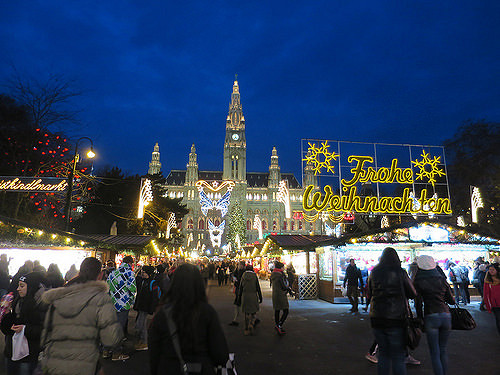
Weihnachtsmärkte Wien

Europe's Christmas markets are well worth experiencing. I'm tempted to list what I consider the best, say of five, maybe ten. But the more that I've pondered this approach, the more I am convinced that each is unique enough to simply to invite you to the nearest one.


Vienna's was my first. I noticed from a distance that its City Hall (Rathaus) was literally a giant Advent calendar, with corresponding numbered windows -- curtained. Beginning on the the 1st of December, the appropriate covering is removed, revealing a Christmas scene. This obviously continues until the 24th -- I could see the centrally located "24". I had to move in for a closer look. I discovered that this Christkindlmarkt is the larger, more commercial of Vienna's numerous Christmas markets.

Yes, there are more -- many more.

Saturday, October 31, 2015

Somewhere in Austria

Another day, another train ride. Alone. Unintentionally, Bogart.

Friday, October 30, 2015

Wien Architecture (1)

Common period architecture, often viewed in Central Europe, this nice example in Wien's centrum.


I think I could manage with a bit of Baroque.


Tuesday, October 20, 2015

Bratislava Architecture (2)

And then there's the, well -- the functional.

Thursday, October 15, 2015

Bratislava Architecture (1)

Often, one stumbles across a grand façade, begging restoration -- this one in Bratislava's Old Town. 


Thursday, October 1, 2015

Street Sign Wien

Straßenschild in Wien -- Siren.

Wednesday, September 30, 2015

Street Performers, Wien

Vienna's street performers can be quite entertaining. On a typical day, rows of silver or gold Victorian statue performers decorate Stephansplatz. Puppet, magic shows, break dancers dispersed. Vying for attention. Timing their performances against each other. Some acts quite good, others a little cheesy. But every crowd acknowledged to have been the best. Tips, please. No pictures without compensation. Thank you.

Friday, July 10, 2015

Out and About, Vienna's Volksgarten

I have often found myself taking a respite on the steps of this temple in Vienna's Volksgarten.

More in line with the timing of Greek Revival architecture, this temple is a neo-classical reproduction of the Temple of Hephaestus in Athens (or the Theseus). Built in the center of Vienna's Volksgarten in the early 1800s, the park was created after Napoleon demolished a bastion near the imperial palace and the temple was added shortly thereafter. The park was further expanded later when Vienna's city fortifications were torn down, replaced by the Ringstraße.

The temple's central location is a natural place to meet, or loiter in transit from one Vienna site to another -- or simply a convenient stop to nibble on a packed lunch. It is a type of theater on the Ringstraße during nice days and evenings, with many of Vienna's landmark buildings in plain view.

Over time, as can be expected, this structure has witnessed change. The temple originally held a magnificent marble sculpture by Venetian artist Antonio Canova, Theseus Fighting the Centaur. The sculpture was removed for some reason in the 1890s, perhaps for safe keeping. It is now a welcoming feature in the Kunsthistorisches Museum nearby. Today, a simple bronze statue, Young Athlete (1921), draws the attention of admirers, the curious -- and occasionally performs as a poster board for late night gatherings and entertainment venues.

The most recent cosmetic renovation is now complete -- the raw stone, covered, painted white. Like most change, I am not sure what to think. Only time, and a few more visits -- hours sitting, watching -- will tell.