Saturday, December 5, 2015

Vianočný Trh, Bratislava

European Christmas markets have been ongoing for centuries. Bratislava's is relatively new, having emerged in the last decade. It's small, cozy and less commercial than larger affairs. There's merchandise to consider but it's the traditional Slovak food and drink which dominates Blava's Centrum and nurtures the festivities. Grilled meats, sausages. Kebabs. Lokse. Potato pancakes, filled with poppy-seed and sweet honey-wine. Or with goose liver, with cabbage. Môžu mať aj inú klobásu, pa prosím? Mňam, mňam!


Tuesday, December 1, 2015

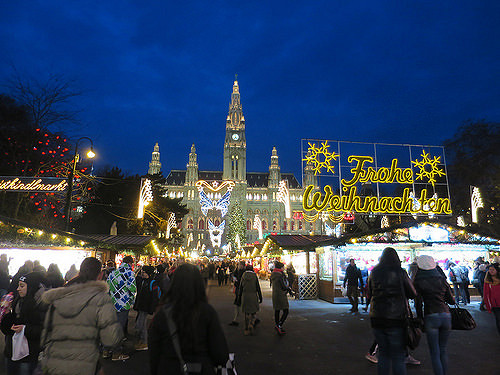
Weihnachtsmärkte Wien

Europe's Christmas markets are well worth experiencing. I'm tempted to list what I consider the best, say of five, maybe ten. But the more that I've pondered this approach, the more I am convinced that each is unique enough to simply to invite you to the nearest one.


Vienna's was my first. I noticed from a distance that its City Hall (Rathaus) was literally a giant Advent calendar, with corresponding numbered windows -- curtained. Beginning on the the 1st of December, the appropriate covering is removed, revealing a Christmas scene. This obviously continues until the 24th -- I could see the centrally located "24". I had to move in for a closer look. I discovered that this Christkindlmarkt is the larger, more commercial of Vienna's numerous Christmas markets.

Yes, there are more -- many more.

Saturday, October 31, 2015

Somewhere in Austria

Another day, another train ride. Alone. Unintentionally, Bogart.

Friday, October 30, 2015

Wien Architecture (1)

Common period architecture, often viewed in Central Europe, this nice example in Wien's centrum.


I think I could manage with a bit of Baroque.


Tuesday, October 20, 2015

Bratislava Architecture (2)

And then there's the, well -- the functional.

Thursday, October 15, 2015

Bratislava Architecture (1)

Often, one stumbles across a grand façade, begging restoration -- this one in Bratislava's Old Town. 


Thursday, October 1, 2015

Street Sign Wien

Straßenschild in Wien -- Siren.

Wednesday, September 30, 2015

Street Performers, Wien

Vienna's street performers can be quite entertaining. On a typical day, rows of silver or gold Victorian statue performers decorate Stephansplatz. Puppet, magic shows, break dancers dispersed. Vying for attention. Timing their performances against each other. Some acts quite good, others a little cheesy. But every crowd acknowledged to have been the best. Tips, please. No pictures without compensation. Thank you.

Friday, July 10, 2015

Out and About, Vienna's Volksgarten

I have often found myself taking a respite on the steps of this temple in Vienna's Volksgarten.

More in line with the timing of Greek Revival architecture, this temple is a neo-classical reproduction of the Temple of Hephaestus in Athens (or the Theseus). Built in the center of Vienna's Volksgarten in the early 1800s, the park was created after Napoleon demolished a bastion near the imperial palace and the temple was added shortly thereafter. The park was further expanded later when Vienna's city fortifications were torn down, replaced by the Ringstraße.

The temple's central location is a natural place to meet, or loiter in transit from one Vienna site to another -- or simply a convenient stop to nibble on a packed lunch. It is a type of theater on the Ringstraße during nice days and evenings, with many of Vienna's landmark buildings in plain view.

Over time, as can be expected, this structure has witnessed change. The temple originally held a magnificent marble sculpture by Venetian artist Antonio Canova, Theseus Fighting the Centaur. The sculpture was removed for some reason in the 1890s, perhaps for safe keeping. It is now a welcoming feature in the Kunsthistorisches Museum nearby. Today, a simple bronze statue, Young Athlete (1921), draws the attention of admirers, the curious -- and occasionally performs as a poster board for late night gatherings and entertainment venues.

The most recent cosmetic renovation is now complete -- the raw stone, covered, painted white. Like most change, I am not sure what to think. Only time, and a few more visits -- hours sitting, watching -- will tell.

Wednesday, July 8, 2015

Out and About, Vienna's Ringstraße

I enjoy strolls along Vienna's Ringstraße for many reasons. The attraction is strong, broadly shared -- I am sure many take a daily excursion around it.

The Ringstraße replaced Vienna's obsolete city walls and moats, which dated back to the 13th century. Measuring 500m wide, the walls were reinforced as a consequence of Turkish assaults which began in the first half of the 16th century. The Ringstraße and its planned buildings, parks, were meant to showcase the grandeur of the Hapsburg Empire -- and perhaps rival the wide boulevard construction which had begun in Paris. The architectural examples are splendid -- neo-classic, neo-gothic, neo-renaissance, neo-baroque, neo-romantic.

For example, full of classic symbolism and an exquisite example of Greek Revival architecture, Austria's Parliament building is impressive. Its Athena Fountain, Pallas-Athene-Brunnen, is most captivating, as it is closest to the Ringstraße and its adjacent sidewalk. Characteristic of classical style, the fountain is full of symbolism, the four reclining figures below Athena (Goddess of Wisdom, holding Nike) represent the four major rivers of the old Austro-Hungarian Empire -- the Danube, Inn, Elbe, and Vlata.

An architectural movement of the late 18th and early 19th centuries, Greek Revival was the last phase of Neoclassical architecture. A product of Hellenism, a result of revived access to Greece (as well as the rise of archeology), Greek Revival took on different forms and styles in Europe -- most often in a craving for Greek style, interior design and furniture. As far as timing goes, Austria's Parliament is a rather late adaptation of Greek Revival. The building and  fountain were erected during the reign of Franz Joseph I, near the end of the Hapsburg dynasty (Parliament 1874-1883, Athena Fountain 1893-1902) .