Saturday, August 25, 2012

One Day in Amsterdam (2)

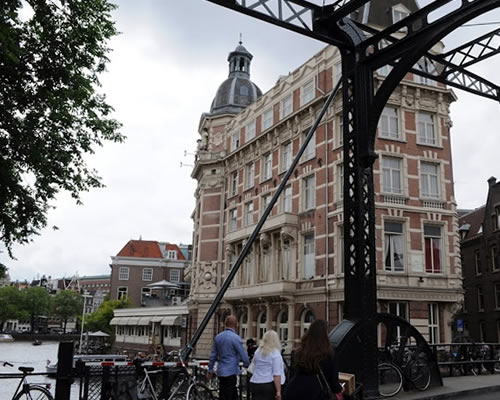
As I wandered around Amsterdam, I noticed most of the houses have a protruding beam near their tops, obviously a centuries old mode for moving heavy objects efficiently up and down from the ground and between various floors. I naturally assumed these functioned to assist in the merchant use of these structures. 
 
On my one day in Amsterdam, I was also fortunate enough to witnesses a modern day use of this function -- perhaps after a quick trip to the local Ikea.


Monday, August 20, 2012

One Day in Amsterdam (1)

I've never had an urge to visit Amsterdam, its reputation mixed with talks of its coffee shops and red light district. The former are difficult to miss, the latter can be avoided. However, Amsterdam's "XXX" symbology is abundant, though I discovered it has little to do with the city’s infamous adult entertainment. To my surprise, the city’s official symbol and coat of arms was chosen centuries ago and only in recent decades has it developed its tie to Amsterdam's sex trade. For sure, an interesting double-entendre.

(As an aside, I briefly tried to find any heraldic background to the city's coat of arms, without much success beyond educated guesses. By the way, the red light district is a seemingly quaint neighborhood and an afternoon can be waisted away at a sidewalk cafe, watching women in their windows -- syrenes beckoning the lost. I was surprised to see groups of locals, literally all types to include families, stroll by, chatting, not paying any attention.)

Away from the main train station, most of Amsterdam's old city center appears residential, with houses lining the canals, the original inhabitants no doubt having had some tie to the merchant trade on the water. That is pretty much what Amsterdam was for me on my first day -- a place to sit and watch, or stroll and take in the canals and architecture, with a variety of styles, most notably Dutch Renaissance, Baroque.

And the endless number of bicycles.


Sunday, July 1, 2012

Wednesday, June 20, 2012

More Graffiti, Bratislava

Along the pedestrian walkway, New Bridge.


Tuesday, June 5, 2012

Graffiti, Bratislava

A locale's graffiti is part social commentary, though not mainstream. It is youthful angst, rebellion -- or clues to what is now, perhaps hip, on the fringe. Or cheap art, the expression of a young mind hoping to influence, or grab attention -- realizing its longevity is measured by the approaching fresh coat of paint.


I have been watching Bratislava's graffiti for awhile now and beyond the scribbles and street-style tags, most has been accomplished with rudimentary stencil and spray, small in scale. Occasionally, there is a work of determined complexity -- free hand or stencil -- street art announcing potential. Has it arrived here?

Bratislava's graffiti-street art subculture may not be as grand or robust as other cities, for a variety of reasons -- but it is still interesting, nonetheless.

Sunday, April 15, 2012

Bulgaria's National Revival

Plovdiv, Bulgaria, is one of my favorite European cities. Allegedly founded by Phillip II (Alexander the Great's father), it exhibits various Thracian, Roman and Byzantine influences. For the first time American tourist, expecting perhaps a Soviet or Warsaw Pact influence, it is readily apparent Plovdiv -- and Bulgaria as a whole -- has managed to remain relatively intact and preserved its unique culture throughout the ebb and flow of Europe's power struggles.


Uniquely, Plovdiv is a showcase for Bulgaria's National Revival, also referred to as the Bulgarian Renaissance, a period of socioeconomic development and national integration while the Bulgarians persevered under Ottoman rule. During this period, Bulgarian literature fueled Bulgaria's struggle for independence, an autonomous Christian church and an armed uprising in April 1876. The revival also found expression in a unique architectural style which can still be observed in Plovdiv and several other Bulgarian towns -- Koprivshtitsa, Veliko Tarnovo.

The national revival is generally accepted to have started with a historical book, written by a Bulgarian monk in 1762, and it culminated with the Liberation of Bulgaria as a result of the Russo-Turkish War of 1877-78. The Paris Peace Treaty, concluded at the end of the Crimean War (1853-56), had obliged the Ottoman Empire to grant Christians equal rights with Muslims. Over time, as insurrections mounted, the continuing oppression of Christians in the Ottoman Empire captured European public attention. So there is a remnant of Russian influence -- it was the Russians who reacted with military force at a key moment in this country's history, enabling Bulgarian freedom from Ottoman domination. In this case, thanks for your assistance, Tsar Nicholas II.

As often is the case, the rise of Bulgarian nationalism erased most of the visible traces of Ottoman occupation. A solitary mosque survived demolition in Sofia, though a mosque and a Turkish bathhouse still accent old town Plovdiv. Soviet domination never was an occupation -- Bulgaria was simply part of an allied buffer against capitalist Europe and the North Atlantic Treaty Organization. Although the Soviets extracted wealth over time from its alliance partners, Bulgaria, and cities such as Plovdiv, never lost their true cultural identities -- or democratic tradition.

Thursday, March 1, 2012

Sir Pálffy, I Presume

An anonymous knight, most likely connected to the Pálffy family (former Pálffy mansion nearby, at which a very young Mozart performed, now the Austrian embassy) immortalized outside an old church wall in Bratislava's Staré Město (old town) -- headless.

Well, you're still looking, um -- spiffy.